

This week’s industry signal: a show-floor discussion still needs a production brief
On October 7, 2026, AMT reported that IMTS 2026 brought buyers and suppliers together around real production problems, technology comparisons and investment decisions. Its report describes a marketplace where manufacturers explored equipment and solutions before taking those conversations back to their shops. For an overseas machining shop or a shaft, coupling or fitting manufacturer, that is the moment when a useful demonstration can become an unclear request for quotation. GEDEMA’s editorial analysis is simple: do not ask a supplier to repeat a generic demo. Use one controlled part-trial brief that lets every proposed process be compared against the same drawing and acceptance method. The industry report is not a GEDEMA customer case and does not establish the suitability of any particular machine.
Why this matters for a shaft or coupling buyer
A machine demonstration can show movement, tooling and a sample part, but it may not match your stock, datum system or feature sequence. A stepped shaft may need a different gripping length and support approach from a short journal. A coupling may combine a bore and turned faces with bolt holes, a keyway or a milled flat. A connector body can add a thread, sealing face and cross hole. These differences decide what must be tested. The buying question is therefore not “Which machine looked fastest?” It is “Can the supplier describe a controlled route for our representative drawing, and can we evaluate the resulting part using our stated requirements?”
1. Freeze the exact drawing and revision
Use a controlled drawing, revision identifier and the intended material condition. Mark the critical dimensions, datums, thread or sealing requirements and every feature outside the basic turned profile. State whether the trial is for one part number or for a family of related parts. If one machine must cover several shafts or couplings, send the smallest and largest representative drawings as well as the feature-rich example. This avoids comparing one supplier’s trial of a simplified part with another supplier’s proposal for the real production part.
2. Specify the blank and permitted gripping surfaces
State whether the trial begins from bar stock, a saw-cut blank, forging or partly machined part. Include the stock envelope, available gripping length, cut-off allowance and surfaces that cannot be marked or clamped. For a longer shaft, show the sections that may need support and any restriction on contact locations. For a fitting or connector body, identify the sealing face and thread areas that must remain protected. A finished-part drawing alone cannot answer these workholding questions, so it cannot by itself make a trial result comparable.
3. Separate turning features from secondary operations
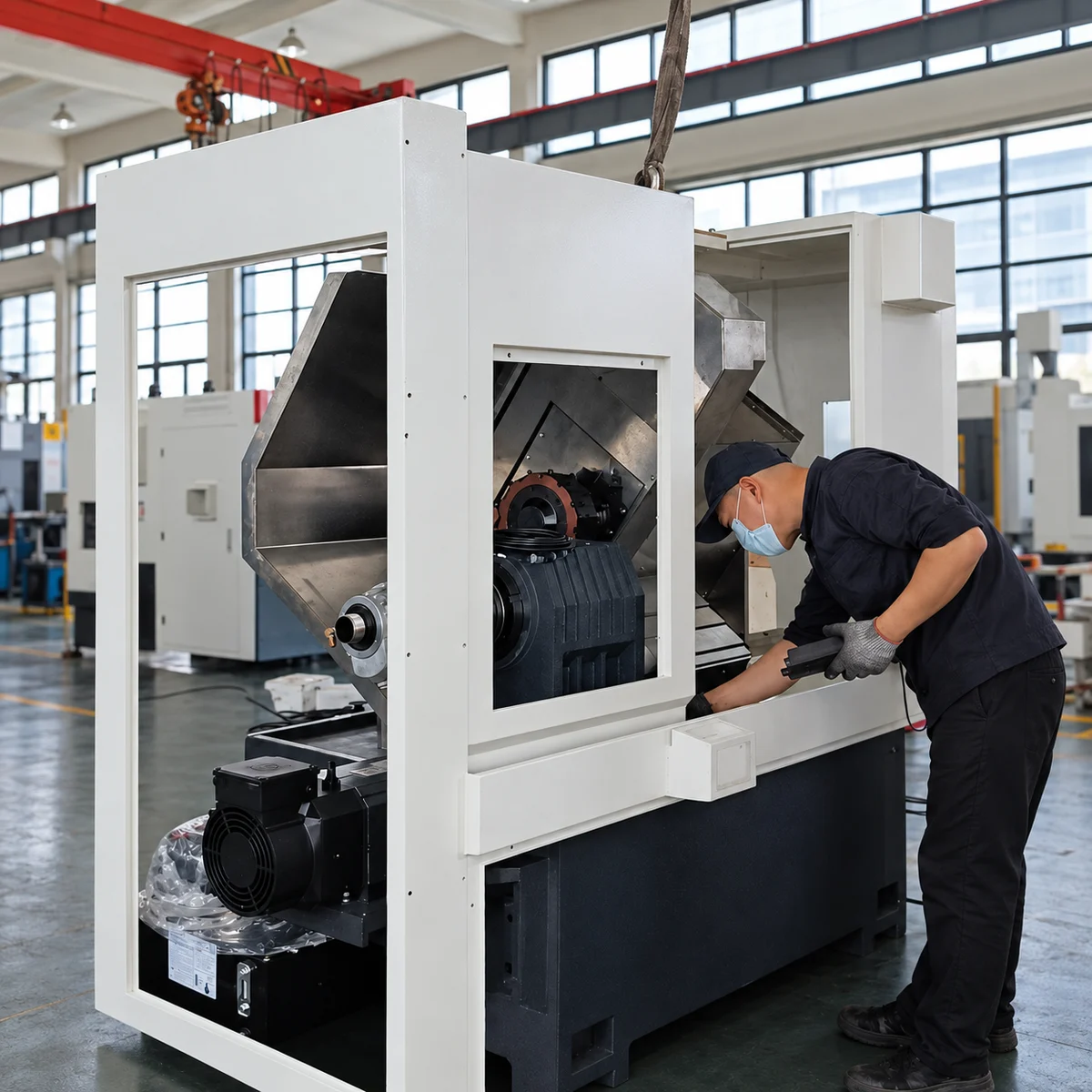
List diameters, faces, grooves and coaxial bores separately from cross holes, bolt-hole patterns, keyways and flats. Then ask the supplier to explain the proposed sequence, tool access and any transfer between operations. This does not require a buyer to prescribe the machine. It gives the supplier enough information to explain whether the drawing is being considered as a turning-focused route or whether drilled and milled features require a different process discussion. Keep that explanation attached to the trial quotation, rather than treating a show-floor configuration as a commitment.

4. Agree on the trial evidence before the part is cut
Before a part is cut, agree on the drawing revision, material, inspection method, records to be supplied and which characteristics are evaluated after unloading. Name the measuring reference or inspection document where one is already required by the drawing. If you need a quoted production estimate, request its stated conditions: tooling, loading method, quantity, inspection frequency and any secondary handling. Do not treat a demo sample, a video, a machine specification or a trade-show claim as proof of your own production result. A trial becomes useful only when the supplier and buyer can identify what was made, how it was checked and which requirements remain open.
5. Keep commercial scope separate from the part-trial result
A successful technical conversation is not yet a complete purchase proposal. Keep the part-trial result separate from the proposed machine configuration, tooling, workholding, peripherals, shipment, installation, training and service scope. Ask the supplier to identify what is included, what remains to be confirmed from the drawing, and what depends on a separate agreement. Record who will review the trial result, by what deadline, and what decision it can support. This protects both sides from treating an exhibition discussion or a sample part as an unqualified commercial commitment. It also gives purchasing a clearer record for comparing proposals that may use different tool packages, fixture assumptions or delivery terms.
Where GEDEMA can enter the discussion
For a shaft-oriented trial, the published GDM-T80-650W information is a starting point for a drawing-led discussion. For a coupling where the drawing includes turning plus drilled or milled features, the published GDM-CX80-650W page can be reviewed. For compact repeat connector bodies, GDM-T40-360D is another published starting point. These links do not select a configuration or promise a trial outcome. Send Us Your Drawing with the material, quantity, critical dimensions, blank form, permitted gripping areas and inspection requirements. GEDEMA can then discuss the part family against published machine information and the process questions in your RFQ.
News sources
AMT — The Association For Manufacturing Technology ·